
RETURN TO AIMZINE NEWSLETTER HOME | June 2009
Investing in Indian Infrastructure –
a fast-track business for Eredene Capital PLC
Aimzine is a FREE online magazine for investors and everyone involved with AIM companies. If you are not already registered to read Aimzine please click HERE
In these times of economic instability, dynamic investors are looking further afield for reliable investment opportunities. Emerging markets are increasingly being seen as a way to beat the slump and achieve a good return on investment. The Indian market in particular has been seen as one area that is still growing while other markets are in decline.
A number of funds have been set up in recent years to offer UK investors access to this rapidly growing market. One such fund is Eredene Capital PLC. After floating on AIM in February 2005, the Company has now earned a market-leading reputation investing in infrastructure projects in India, primarily in logistics, distribution warehouses and port services.
Eredene has made nine investments to date in a broad geographic spread across India – committing up to £51 million with local partners in joint ventures which include four container handling facilities, three logistics operations and a large-scale urban infrastructure development. It expects seven of the nine to be revenue generating by the end of 2009.
Aimzine spoke to Alastair King, Eredene’s Chief Executive (pictured right) to find out more about the investment case for India and how this area is faring in the downturn, as well as details of their specific projects.
Incentives for investing in Indian Infrastructure
According to Eredene, the incentives for investing in Indian infrastructure are clear. “India is an investor friendly environment. Foreign direct investment in infrastructure is one of the priority areas for the Government of India” explains King.

The Indian government publishes five-year plans for its macro economic policies. The 11th five-year plan, which covers the period from 2007 to 2012, has particular targets relating to the country’s infrastructure. “Investing in infrastructure is also rather more transparent than it might be in other sectors”, King continues. “Foreign direct investors can take up to 100 per cent stakes in ports, whereas there are ceilings for example in foreign investments in airports and retail”.
King, who founded Eredene with the original intention of investing in Indian real estate as well as infrastructure projects, has first hand experience of the advantages on offer in the infrastructure sector. “In our real estate projects we found ourselves in many cases competing against a large number of other funds and we didn’t see value there for investors,” he says. “The steady cash flows that infrastructure investments generally provide are attractive in these straightened times. Our viewpoint from India is that it is a beacon of growth in a stalled or negative growth world.”
India and the current economic environment
While India is no safe haven from the current economic conditions, it can offer relative security for investors. Indian domestic demand is expected to see steady growth as the urban population is predicted to double over the next decade to 575 million. India remains one of the world's fastest growing economies, “It is estimated that the Indian economy will still grow 5.3% in the course of 2009” explains King, making this economy of 1.2 billion people one which will still exhibit one of the highest global growth rates. While 5.3% is considerably less than figures that were talked about before the global downturn took hold, King remains certain; “There are a lot of positives in the Indian economy and the infrastructure sector is a safe bet.”
Interestingly, the banking sector in India remains relatively stable. Around 65% of India’s banks are owned by the State with virtually no exposure to international sub-prime lending, derivatives and capital markets. As the banking system is primarily owned by the State, the Indian Government can direct debt finance to the areas where its priorities lie. “The areas we specialise in – port to port services, distribution warehousing and transport – are among the high priority areas,” King points out, “so availability of debt capital is not a constraint”.
Practicalities
The relatively simple legal process and the common language also seem to speed up processes that many presume would be long and arduous. “The image conjured up by saying that you’re investing into India, plus you’re also investing into infrastructure projects, is that of a slow process,” he says. “I think that we have proved that India does not have to be a slow process, things can move pretty quickly. We can get revenue streams early on. In our portfolio, for example, we have a container handling facility at Chennai which two years ago was green fields belonging to a farmer and is now profitable, and in the next few months we anticipate that this investment will become dividend paying. To see a whole cycle from green field to dividend within two and a half to three years we think is extremely attractive.”
Local Partners
the steady cash flows
that infrastructure
investments generally
provide are attractive
availability of debt capital
is not a constraint
Doing business in India requires a network of contacts. The phrase ‘It’s not what you know it’s who you know’ is of huge importance here and investors should look for the Indian contacts any UK-based investor has. Eredene has an excellent advisory team on the ground, led by Nikhil Naik, formerly Regional Director for P&O Ports for the South Asia (India, Pakistan, Sri Lanka) and Middle East regions. King is convinced of the benefits of having such an industry specialist on board. “Nikhil is an extremely experienced operator who knows the logistics, transportation and warehousing, and ports sector intimately,” he says. “He has a successful record in sourcing, evaluating, developing and managing large infrastructure projects throughout South Asia”. Nikhil is now a Non-Executive Director for Eredene, and provides the company with infinite value through his contacts as well as his industry expertise; “Nikhil’s former P&O team helped us to establish a network of excellent partners in India. These partnerships have proved invaluable and we have made several investments with some of them.”
Eredene raised US$100million in 2006 and they now have 92% of this money invested in nine projects spread across India. King highlights how the Company have sought out local partners to build relationships with. “We have an exclusive partnership in India’s eastern states with Apeejay Surrendra Group, a big shipping group which is well known in the UK as the owners of Typhoo Tea. We have made two investments with them to date in Logistics Parks in eastern India.” Another important partner is Contrans Logisitic, with whom Eredene has invested in projects in the fast-growing state of Gujarat. “We have jointly invested in a seaport container freight station at Pipavav and a rail and road container facility near Baroda, and we are looking to make a possible third investment with them,” says King.
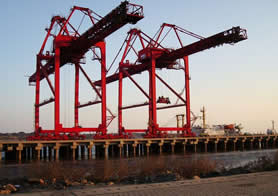
container freight station at Pipavav
Further Opportunities
In terms of plans for the future, Alastair King and his team at Eredene have their sights set on India’s railways including rail freight operators, rail equipment manufacturing companies and signaling equipment manufacturers. Again support from the government will be important. “The Indian Government has part privatised the rail container sector through the issuance of 15 pan-India rail licenses to domestic and foreign companies which allows license holders to operate container trains on a pan-India basis,” King told us. “The total target funding for railways in the 11th five year plan is around US$75 billion. Indian Railways ("IR") has already announced plans to invest US$46.7bn for the modernisation, and of this, they plan to attract approximately US$24.63bn through PPPs.”
Financials
Eredene will issue their final results at the end of June. Aimzine will comment on these results and look at the investment considerations for Eredene in next month's edition.
If you would like to comment on this article please click here or visit our SocialGo site
Copyright Aimzine Ltd
RETURN TO AIMZINE NEWSLETTER HOME | June 2009
This article is the copyright of Aimzine Ltd. No part of the article should be copied, reproduced, distributed or adapted in any way without our prior consent. |