
Aimzine is a FREE online magazine for investors and everyone involved with AIM companies. If you are not already registered for Aimzine please click HERE |
Avacta Q&A
Question and Answer Session with Alastair Smith, CEO of Avacta Group
Avacta, first covered by Aimzine in July 2010, provides technologies and services to the pharmaceutical and diagnostics markets. We recently caught up with CEO, Alastair Smith, to ask a number of questions concerning recent significant developments at Avacta. In particular, there has been a new European distribution agreement with Dutch distributor Isogen Life Science as well as the long anticipated launch, on 23 November 2010, of its MIDAS point-of-care diagnostic instrument, now re-branded as the AX-1. The questions are written in black and the responses in blue.
1. The AX-1 is being launched with one test available. In the FY Results you have stated that “following the launch there will be a programme to develop a menu of tests”. This is an important aspect and marketing of further tests would certainly assist early sales and ultimately successful penetration beyond “in-field” testing (not to mention delivery of such tests). So, can you detail the list of tests in that programme and also the associated development to launch time for each?
We will concentrate initially on tests for the veterinary market, but as we have said before, the human point of care testing market is a longer term goal for Avacta as it grows. The tests we will launch with the AX-1 (it was called Midas during development but is launched as the Avacta AX-1) will be based on some of our own proprietary tests that are currently offered as lab services and also on a wider range of tests outside our current product range which is focused on allergy and acute phase proteins. I am a little wary about giving a detailed list at this stage since it would provide advanced warning to competitors but I can say that we are looking at a wide range of possibilities and ensuring that the tests we develop have the best chance of commercial success

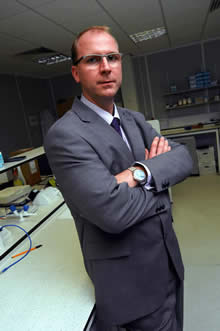
CEO Alastair Smith
2. With the right partner, realistically how quickly could AX-1 enter the human POC (Point-of-Care) market?
The key here is to put tests that already have regulatory approval onto the AX-1 platform. Under these circumstances, the regulatory requirements are reduced and essentially entail demonstrating equivalence with the existing test. That said, it is still a 1-2 years process so we would not anticipate a human POC application before the end of 2012 or into 2013. The veterinary opportunity is substantial though and shareholders should certainly not assume that the success of the AX-1 is based on human applications. The human POC market provides a much bigger story that we will move towards as quickly as possible.
3. MIDAS is described as fully automated, so could it achieve CLIA (Clinical Laboratory Improvement Amendments - https://www.cms.gov/clia/)waived status (i.e. use by non trained staff) in the US?
We have not looked into this in detail yet but as your question implies, this is the basis of the CLIA waiver scheme. If it is simple enough to operate that an untrained user cannot make an error then it has a good chance of achieving CLIA waver status and we believe that would be the case.
a much bigger story
4. AX-1 is also described as being capable of testing for multiple biomarkers in a single test, i.e. multiplexed testing. What are the limitations in terms of numbers - two, ten or more?
The AX-1 has the potential to deliver multiplexed tests. We are looking into two methods to achieve this that could be integrated with the AX-1 and have had early successes. In principle, we have shown that it may be possible to detect many tens or even hundreds of proteins in a device based on the AX-1 but I suspect that most applications that we would want to address would focus on a small handful of say, 3 – 10 proteins, which looks eminently feasible with the AX-1 platform. When Avacta is able to put resources behind this important development, I will be able to say more about the timelines for such a development.
5. Given ELISA (Enzyme-linked Immunosorbent Assay) testing is more complex and sensitive than lateral flow testing; can you give us a guide to how much time is taken to perform an average test?
I don't wish to be evasive in my answer but the time taken to perform a test is entirely dependent on the test. The key aspects are the efficacy of the capture and reporting reagents (usually antibodies) and the concentration of the biomarker for which you are testing. We believe that the range of times for the AX-1 will be from fifteen minutes for the “easier” tests up to one hour for the more challenging. The first test, which is an allergy screen, would be classed as a more challenging test and this is complete in about fifty minutes.

6. Is it realistic to get the AX-1 unit out into human POC market by 2012 when you bear in mind the regulatory barriers that must be got through?
Depending on the approach taken, I think that it is possible to achieve this by the end of 2012. Our strategy is to find partners with existing tests as discussed in question 2. Realistically, how soon we can launch a product in the human market will depend on finding the partner and committing resources to the development and at the moment we are right at the very start of that process and see nearer term revenue opportunity in the veterinary market.
7. Is AX-1 going to be built in the UK independent of Avacta?
Avacta will build the AX-1 until volumes dictate that we must consider outsourcing the build or investing further in our own facilities.
-
Are the cartridges going to be manufactured in the UK independent of Avacta?
- Is the filling / assembling of such cartridges going to be carried out within Avacta?
The filling and assembly of the cartridges will be carried out in Avacta until volumes dictate that we must consider outsourcing or invest further in our own facilities.
-
Is the rollout and scale up for all of these elements achievable within existing budgets and facilities?
The cartridges are moulded in the UK by a third party.
Avacta has just moved its manufacturing and R&D to larger facilities and there is ample scope for further expansion at minimal cost. We have an excellent Product Development and Production Manager and we are growing the team. Therefore, I expect that if it were the right commercial decision to expand our manufacturing facilities then I believe that we would be able to achieve this smoothly.
8. Market interest in AX-1 was previously described as strong, so can you qualify that separately for animal health and then for human health?
I can’t really say much about the human health market. We have had initial conversations with a handful of potential partners, so clearly there is interest in POC testing as we all already know. In the veterinary market, we have a close relationship with many vets in the UK and have got valuable feedback from them on the commercial direction the AX-1 should take. Time will tell and the expansion of the menu of tests to include the right options will be key, but veterinarians are leaders in adopting new technologies to improve the care they provide and I am sure that the interest that has been shown to date will transform into numbers of units in the field.
9. Following our previous conversation, how will the AX-1 unit be funded by your prospective customers? Will it be cash up front by them and then a commitment to purchase a certain number of cartridges from you per year? Or, will they pay a leased cost every time they use the AX-1 unit? So, you will effectively be funding the cost and manufacture on your balance sheet? For example, when we discussed OPTIM, we talked about the necessity of leasing the units to your prospective customers due to the high budgetary costs of purchasing one of these units in the current economic environment. Naturally, the AX-1 unit is much less to purchase.
I believe that it will be a mixture of the two of these models but it is too early to say for definite. However, with the lower cost of the AX-1, a placement or leasing model is attractive and achievable. We have already identified a partner to allow us to offer different purchasing models. Our primary goal is to get numbers of units out there and to scale up the recurring revenues through the tests.
10. Are you of the opinion that you will not need to go back to existing shareholders for more funds in order to support the growth of AX-1? i.e. will you be able to fund the expansion through your existing cashflow?
We take a view that we should plan and strive to grow under our own steam but that, clearly, the bigger wins that Avacta could deliver would need to be resourced if we are to deliver on a short-time scale. Any fund raising should be seen as positive investment in growth.
11. Are the revenue numbers released by your house broker (XCap) a little on the conservative side? I think you have indicated £3.4 million (July 2011), £7.7 million (July 2012).
I think that the numbers released by XCap are sensible.
will depend on finding
the partner
just moved to larger facilities
strive to grow under
our own steam
12. How are things progressing with a new distributor for Optim in the US market? Is any news expected before the 31st December 2010?
Progress is being made and we have been approached by others who wish to take on distribution in those markets, so I am confident that we will appoint a good US distributor in the relatively near term.
13. What is happening with the completed Curidium / Takeda project? Do you retain the IP from this? Is there value to be had with other prospective partners / companies or internally within Avacta?
I am working hard with Curidium to move forward from the completed Takeda collaboration. In my view there is a potentially very interesting opportunity here for Avacta Group and the most likely route is working with partners who can harness the unique approach that we have to patient stratification and commercialise it quickly. My only concern is about the timescale upon which we can make things happen with large pharma partners, given tight resources in the Group. However, I have a clear plan which gives me plenty of scope for managing resources and the timing of taking the Curidium assets forward.
14. From your broker’s note, it is estimated that there are 5,000 vets in the UK, a further 25,000 in the rest of Europe and 25,000 in the US. How will you sell the MIDAS concept? Will it be via distributors or direct sales? Or, a combination of both?
A combination of both. We will focus on the UK initially through our own direct sales and possibly distributors. Other markets, the EU being first, will be addressed through distributors.
15. How well was The City presentation on the 23rd November received?
It was an audience of analysts and journalists as well as a couple of corporate investors. The feedback I have had directly is that it was well received. AX-1, alongside Optim, is a fantastic advert for what can be achieved on a relatively modest level of investment and I hope that Avacta has now demonstrated clearly that it can deliver. We now need to execute the commercialisation of these products and recent progress is very encouraging. We will be shipping AX-1 in the New Year and I am really looking forward to building up the range of tests and establishing the AX-1 as a POC testing platform upon which the diagnostics side of Avacta Group can be built.
Alastair, thank you for taking the time out to talk with us. We are very much looking forward to updating our readers in the coming months regarding further Avacta progress.
a potentially very interesting opportunity
AX-1, alongside Optim, is a fantastic advert
Questions by Simon Murphy
Copyright © Aimzine Ltd 2010
This article is the copyright of Aimzine Ltd. No part of this article should be copied, reproduced, distributed or adapted in any way without our prior consent. |